1. Introduction
The aUToAntiBody Comprehensive Database, or UT-ABCD, is a collaborative development established by The University of Tokyo and ProteoBridge Corporation. This database provides high-dimensional data on autoantibody levels in serum across various human diseases.
Autoantibodies are measured using the HuPEX® comprehensive protein array, which displays 13,352 autoantigens. This makes the database valuable for diagnosing and researching various conditions, including autoimmune diseases.
1.1. Construction of UT-ABCD
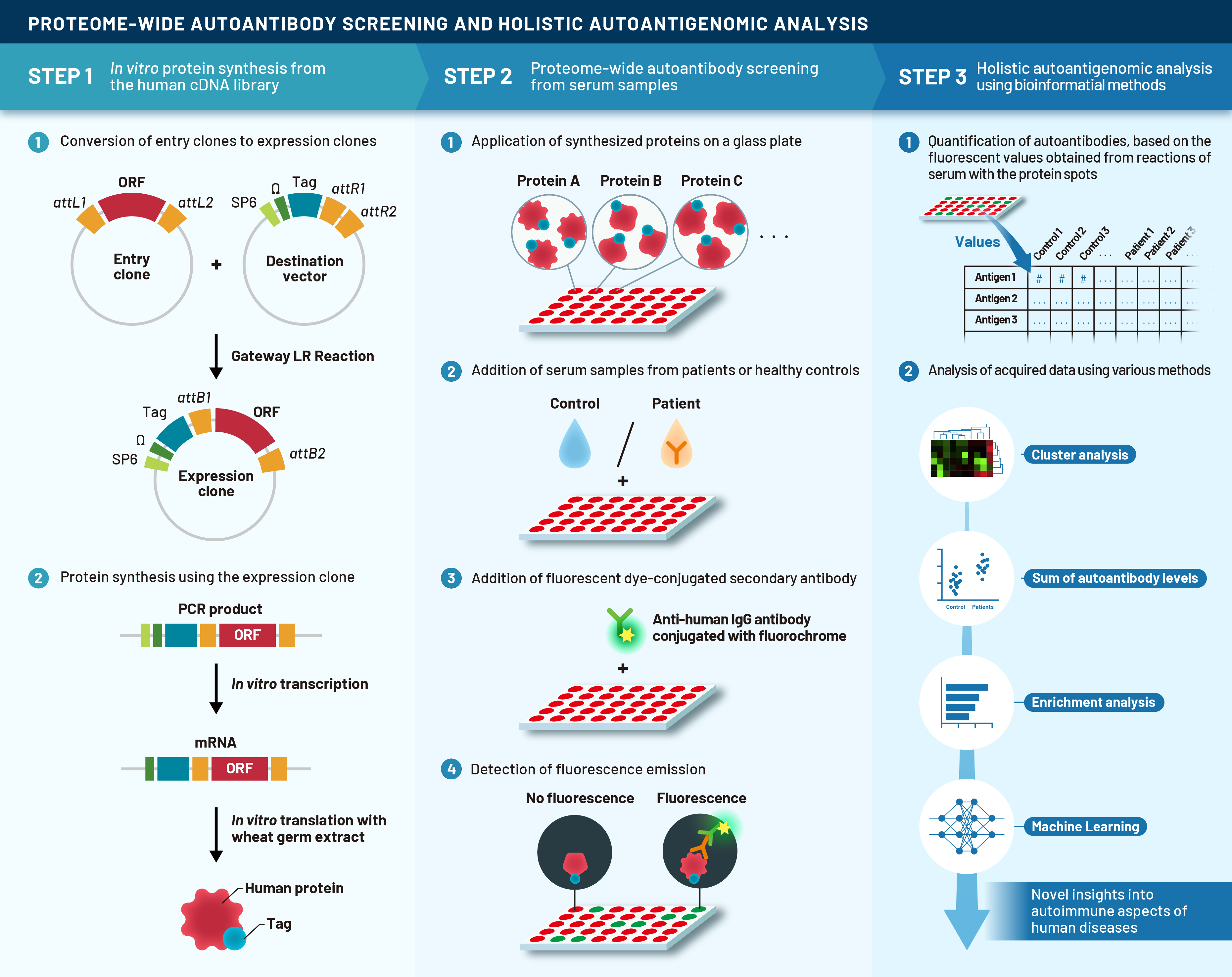
UT-ABCD was built through the following three steps:
-
Step 1: Protein Synthesis
Proteins were synthesized in vitro from a human cDNA library (HuPEX). Promoters (P), enhancers (E), and FLAG-GST tags were fused to the open reading frames (ORFs) of expression clones via Gateway LR reactions. After amplification by polymerase chain reaction (PCR) and in vitro transcription, protein synthesis translation was performed using a wheat germ cell-free system.
-
Step 2: Proteome-wide autoantibody screening
The synthesized proteins were arranged on glass slides to create protein arrays. These arrays were then reacted with serum samples derived from patients with diseases or healthy controls (HC), and attached autoantibodies were detected using fluorescent dye-conjugated anti-human IgG secondary antibodies.
-
Step 3: Autoantibody Quantification
Autoantibodies were quantified based on fluorescent signal values. The high-dimensional autoantibody profiles obtained in this way can be analyzed using various omics analysis techniques.
References
-
Goshima N, Kawamura Y, Fukumoto A, et al. Human protein factory for converting the transcriptome into an in vitro-expressed proteome. Nat Methods. 2008;5(12):1011–7.
-
Sawasaki T, Ogasawara T, Morishita R, Endo Y. A cell-free protein synthesis system for high-throughput proteomics. Proc Natl Acad Sci U S A. 2002;99(23):14652–7.
-
Fukuda E, Tanaka H, Yamaguchi K, et al. Identification and characterization of the antigen recognized by the germ cell mAb TRA98 using a human comprehensive wet protein array. Genes to Cells. 2021;26(3):180–9.
-
Matsuda KM, Yoshizaki A, Yamaguchi K, et al. Autoantibody Landscape Revealed by Wet Protein Array: Sum of Autoantibody Levels Reflects Disease Status. Front Immunol. 2022;13:1–14.